Regional focus
Rebuilding under fire: Ukraine’s construction sector fights on amid war
From shattered bridges in Hostomel to rising costs, labour shortages and corruption risks, Ukraine’s builders are keeping reconstruction alive while preparing for an uncertain post-war boom. Greg Noone reports.
Main video supplied by Shutterstock
Powered by

Last year, Zhanna Gozha returned to the bridge where her son had died. The structure – an unremarkable motorway crossing over the River Irpin – appeared just as it was on 24 February 2022, when Ukrainian Army Lt Zakhar Kvasny was tasked with its destruction. Earlier that day, Russia launched its full-scale invasion of Ukraine, with fighting around Hostomel Airport forming part of the push towards Kyiv. All that stood between them and taking the city was the eponymous motorway bridge, Lt Zakhar Kvasny, Sgt Roman Shymansky and a pile of plastic explosives.
Eventually, a Russian military convoy rumbled into view. Kvasny and Shymansky waited until its heavy vehicles were on the bridge before they blew it sky high, sending torn men and vehicles tumbling into the river below. In the ensuing battle, however, both men were killed. Photos after the event show the bridge’s left-hand section sagging like damp cardboard into the Irpin, but when Gozha returned all those years later, there were few clues that the crossing had been destroyed at all. Similar reconstruction has taken place in parts of Hostomel. By 2023, approximately 900 buildings had been restored in the town, though reconstruction activities were briefly tainted by corruption after it was revealed that the local military administration had misappropriated $567,000 in funds to rebuild homes for displaced citizens.
Reconstruction gathers pace off the front line
Local authorities have since overseen the construction of a new, energy-efficient school and military town project in Hostomel; the works are now emblematic of the ambition and industry of a Ukrainian construction sector operating under the greatest duress in history. Despite working under Russian drone and missile fire, the sector actually grew by 24% to about €5.3bn last year in monetary terms according to Andriy Ozeychuk, the chief executive of Rauta, a general contractor for commercial buildings construction projects, in an article for the GMK Centre, a Ukrainian consulting company – with the strongest levels of growth occurring in Lviv and Kyiv.
Even so, the war has clearly taken its toll, with the overall size of the industry approximately one third less than it was in 2021, when the construction market reached €8bn.
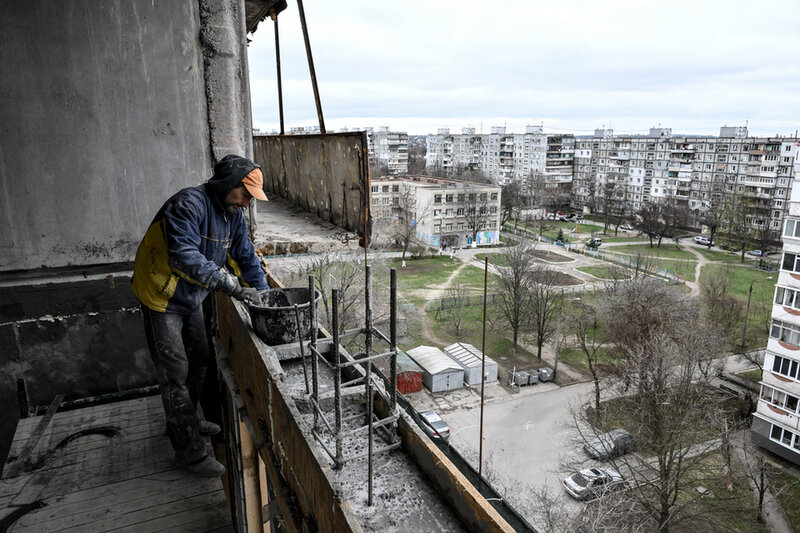
Restoration of apartment block damaged by Russian attack in Zaporizhzhia. Credit: NurPhoto/Getty Images
None of this is surprising, argues Olena Rybak. “The country’s at war, but life goes on – this is what is important to understand, as cynical as it sounds, and awful,” says Rybak, the managing director of the engineering consultancy iC Ukraine. In her role, Rybak manages a team of 60 people supporting the implementation of €200m of international financial institution (IFI) or donor-funded projects across Ukraine, including work on water and heating infrastructure, housing for internally displaced people and repairs to bridges into Kyiv – Hostomel among them.
Such grants and loans have helped fund reconstruction, often with conditions on financial transparency. Many firms now meet these conditions, says Rybak, though corruption remains a problem. According to the deputy head of Ukraine’s National Agency on Corruption Prevention, Serhii Hupiak, “the construction sector is among the top seven most corruption-prone sectors” and remains “full of risks”.
Rising costs and labour shortages hit home
The sector also faces more immediate challenges. One is the threat of drone and missile attack, though when the air raid sirens go off, explains Ozeychuk, work crews tend to down tools and run to nearby shelters like everyone else. Those tools, however, along with materials, are becoming increasingly expensive to acquire. “Our construction prices are increasing 10%, 15%, 20% every half a year, roughly,” says Rybak. Pay for construction workers has shot up recently, too – the average pay for a bricklayer, for example, increased by 31% in the past year.
That’s partly down to a dearth in labour across the sector, with most of the country’s qualified electricians, machine operators and labourers serving on the front lines. In the early days of the war, whole brigades of workers were mobilised for military service by the government. Those incidents are rarer, but even now, “there is a certain percent of my male staff that I cannot secure from mobilisation”, says Rybak. “There are things that we can influence and those that we cannot,” though she stresses that there’s nothing inherently wrong with releasing staff for military service (“Someone has to defend the country.”)
Rauta, too, has seen 20% of its staff mobilised for military service. At other firms’ work sites around the country, this has slowed down building work to a snail’s pace: where once even the smallest companies could reliably recruit a crew of 25, this is now down to four or five individuals, explains Rybak. “This means they cannot build [a project] in two years,” she says. “They will be building in four years, if we are lucky.”
There is no obvious solution to this problem. Absent a swift and surprising peace deal, foremen get workers where they can. “Construction companies are actively recruiting pensioners and women to perform work that does not require significant physical exertion,” says Ozeychuk, with workers becoming equipment operators, welders and drivers. Others, he continues, have begun to recruit specialists from abroad, with the government proposing to relax migration rules and some agencies have advertised recruitment and relocation services for foreign workers. This effort, however, appears to be nascent: for her part, Rybak has seen little evidence of foreign labourers appearing at Ukrainian construction sites.
Preparing for peace, hoping for the rebuilding boom
These problems are arguably leaving the Ukrainian construction sector ill-prepared for peace. Inflation is likely to get worse when that moment arrives, argues Ozeychuk. “In the post-war period, we expect an increase in demand for building materials, equipment and personnel by two or three times, because most investors and donors are already actively calculating the cost of construction and waiting for the end of hostilities to start new projects,” he says. “An additional risk for Ukrainian producers may be an increase in imports of building materials from the EU and China.”
Despite these fears, there’s been plenty of debate in Ukraine about how it should rebuild when peace is declared. Essentially, the arguments boil down to two: either Ukraine should ‘build back better’ with more sustainable building materials and technologies – like heat pumps that are more efficient than the decrepit, Soviet-era district heating systems that predominate in many cities across the country – or use methods and materials that guarantee Ukraine’s swift reconstruction, the better to get the country back on its feet.
“Ideologically, I’m for the better – and then, you have reality,” says Rybak, who would rather only keep her neighbours waiting for a new apartment for two years rather than the four likely required by the exclusive use of sustainable construction methods. But that doesn’t mean there isn’t wiggle room for adding new technologies here and there. Heat pumps are a prime example. Including them within reconstructed apartment blocks, says Rybak, affords that neighbourhood the chance to run independently from a gas grid vulnerable to Russian strikes and global price fluctuations. It just “makes sense economically, technically, financially and ecologically”.
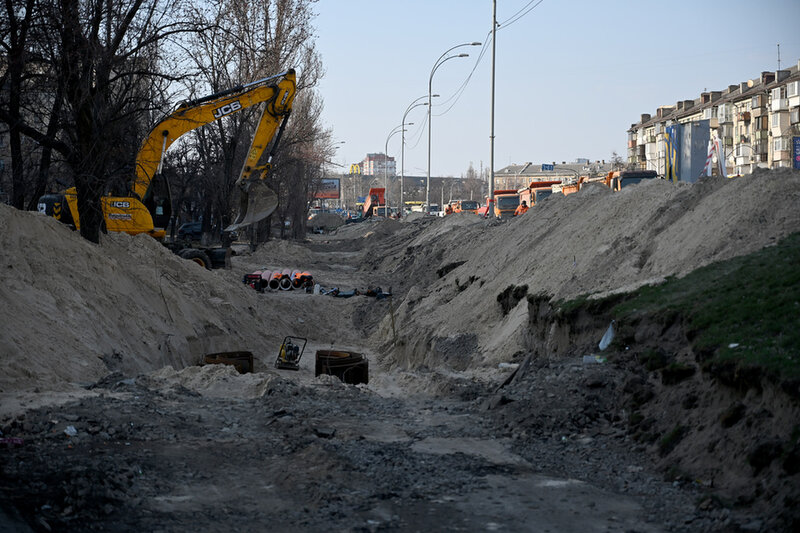
Overhaul of Kharkiv Highway in Kyiv. Credit: NurPhoto/Getty Images
Many such opportunities for improvements continue to be missed, argues Rybak – which, given the current circumstances, is understandable. “People are exhausted,” she says. What would really accelerate Ukrainian reconstruction efforts, argues Rybak, would be the arrival of large German or Scandinavian enterprises. But when she attends international construction conferences and actually asks these companies when they intend to act on their promise to enter the Ukrainian market, only one answer is given: “When the war is over.”
They should rethink their position, argues Rybak. In February, the United Nations estimated that the full-scale reconstruction of Ukraine would cost $588bn, an opportunity for foreign companies willing to establish an early presence in Ukraine. But the foreign firms that will thrive, says Rybak, will be the ones that arrive early. If they’re waiting until a €50m project is announced, she continues, “they’re probably going to lose it to one of the stronger companies that is already here,” either from Ukraine or another Western nation.
Welcoming these companies to Ukraine would be more than a vote of confidence in the country’s construction sector. Their assistance in rebuilding the country would provide the additional labour, financing and expertise to help many Ukrainians realise their dream of a strong, democratic and Western-aligned nation – a future that Kvasny and Shymansky would doubtless have looked forward to seeing, too.

