

Analysis
Global construction learns to operate without a steady state
Thin growth returns in 2026, but the real shift is structural: deliverability, not demand, now determines what gets built, according to GlobalData’s latest findings. Thom Atkinson reports.
Main video supplied by Ilia Levchenko/Creatas Video+ / Getty Images Plus via Getty Images
Powered by

The global construction outlook is edging back into positive territory. On paper, that looks like a recovery. In practice, it is something more awkward: a return to growth in an industry that has lost the comfort of stable assumptions.
Worldwide construction output is forecast to grow by 1.5% in 2026 after a 0.2% decline in 2025, according to GlobalData’s Global Construction Outlook: Key Trends and Opportunities to 2030 (Q1 2026). Those figures are important, but they are not the whole story. The more useful signal is what sits beneath them: geopolitical disruption, elevated input costs, strained labour markets, tighter finance and a growing question over which projects can be delivered profitably.
Demand has not disappeared. Governments still need transport networks, grids and utilities. Corporates still want logistics capacity, semiconductor plants and data centres. What has changed is the threshold for turning that demand into viable work. The industry is now deliverability constrained.
That is why the global construction disruption outlook is a test of commercial discipline.
Cost becomes the binding constraint
GlobalData’s report makes clear that cost pressure is being shaped less by ordinary cyclical demand and more by disrupted trade, energy volatility and supply chain fragility. Since Donald Trump’s “Liberation Day” tariffs on 2 April 2025, contractors have had to price work around shifting supply conditions and heightened disruption. Continuing conflict in the Middle East has added further pressure through energy markets, with building material prices expected to remain elevated through 2026.

1.5
%
Global construction returns to growth in 2026, but only marginally, signalling recovery
without stability.
GlobalData
This changes behaviour. Fixed-price exposure becomes harder to accept without larger contingencies. Procurement teams move from lean sourcing to defensive sourcing, with dual suppliers, regional supply chains and clearer escalation clauses. That can protect delivery, but it also raises upfront costs. Some projects no longer clear the investment hurdle.
For clients, the implication is uncomfortable. Cost is no longer a variable to manage at
the margin. It is becoming the factor that determines whether projects proceed, pause, shrink or are redesigned entirely.
Growth is becoming more selective
The sectoral picture reinforces that point. GlobalData expects five of the six construction segments to grow in 2026, with residential the only decliner. That would mark the sixth contraction in residential activity in seven years, with 2021 the sole exception. In many markets, affordability and financing constraints have turned residential weakness into a structural drag.
Infrastructure, and energy and utilities still grow, but with less force. Infrastructure output is forecast to rise by 3.8% in 2026, while energy and utilities grow by 2.1%. Both are well below the 7.3% and 6.3% recorded in 2024. Ambition remains strong, but execution is harder.

3.8
%
Infrastructure growth slows sharply from recent highs, showing execution – not demand – is the real bottleneck.
GlobalData
The better opportunities sit in strategic capital expenditure: logistics, semiconductors, power infrastructure and AI-related data centres. These are complex assets, not simple volume plays. In practice, contractors need engineering depth, commissioning capability, supply chain control and disciplined project management. Chasing turnover is not enough. It may be dangerous, in fact.
The same logic applies to megaprojects. GlobalData’s reference to the scaling back of Saudi Arabia’s ‘The Line’ is a useful warning. Large pipelines can look secure until funding, phasing or political priorities change. Contractors building strategies around uninterrupted megaproject ramps should be careful. The ground can move quickly.
Middle East conflict sends a fresh cost shock through construction
The escalation of the conflict involving Iran across the Middle East rippled through construction less via direct damage and more through energy, shipping and materials markets. GlobalData warns it is reigniting fears of another cost inflation wave, blunting expectations of near-term rate cuts and adding pressure to contractors already operating with thin margins and limited pricing power.
That shock is landing as advanced-economy construction started 2026 on fragile footing. GlobalData forecasts 0% output growth across OECD markets in 2026, after a 1.4% decline in 2025. The UK’s ONS reported on Friday 13 March 2026 that seasonally adjusted construction activity fell 2% quarter
on quarter in Q4 2025, while US data cited in the report indicates the construction industry lost 11,000 net jobs month on month in February 2026. With inflation risk rising again, weaker demand and tighter finance could persist for longer than many in the industry had hoped.
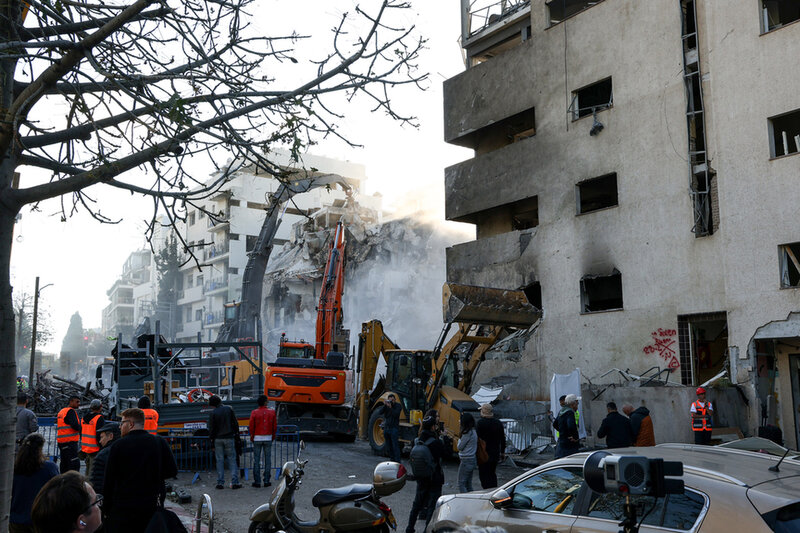
Construction workers and heavy machinery demolish and clear a residential building severely damaged by a ballistic missile strike during the Iran–Israel conflict. Credit: MstudioG/Shutterstock
Energy is the fastest-moving transmission channel. GlobalData highlights disruption in the Strait of Hormuz, citing the US Energy Information Administration’s estimate that around 20 to 21 million barrels per day pass through the strait, about 20% of global seaborne oil flows, and roughly 20% of LNG flows. Oil prices moved above $102 per barrel after rising 40% since the conflict began, triggering an International Energy Agency coordinated release of 400 million barrels from emergency stockpiles. Higher fuel and power costs quickly feed into energy-intensive materials such as bricks, steel, concrete, bitumen and asphalt, while also lifting site logistics and plant running costs. In the US, the American Automobile Association figure quoted by GlobalData shows regular gasoline (petrol) at $3.70 per gallon on 15 March 2026, up 26% from a month earlier.
Supply chains are tightening too. GlobalData notes pressure on aluminium and petrochemical-derived inputs used across modern construction, alongside shipping disruption as carriers avoid Hormuz. Rerouting via the Cape of Good Hope can add 14 to 20 days to delivery times, and freight rates are moving.
And exposure is not uniform. Goldman Sachs Investment Research noted non-energy trade with the Gulf is around 1% of global commerce, and cites the UK Construction Products Association’s estimate that roughly 75% of UK construction products are sourced domestically, limiting the risk of direct import shortages even if global price effects still filter through. The immediate industry challenge, however, is universal: protect procurement and delivery plans against a shock that is turning volatility back into the baseline.
Source: ‘The Middle East Conflict – The Impact on Global Construction’
Regional divergence sharpens
The regional outlook is less a single global cycle than a set of uneven tracks. North America is forecast to grow by 1.3% in 2026 after a 0.8% contraction in 2025, with the US up 1.1% and Canada up 2.6%. Policy support and public programmes help, but tariff-related uncertainty and material costs remain a drag.
Western Europe is expected to grow by 1.8%, supported by transport, energy and renewable infrastructure. Yet contractor insolvencies, labour constraints and tight cash flows continue to bite. Italy is forecast to contract by 1.5%, while Spain is projected to grow by 4.5% after 5.6% in 2025. Even within one region, the spread is wide.
Eastern Europe is forecast to grow by 2.8% in 2026, slowing from 5.6% in 2025. Ukraine is projected to be the fastest-growing market at 13.2%, driven by reconstruction and military-related expenditure. That is a major opportunity, but not a straightforward one. Funding, security, capacity and delivery risk all matter.
North-East Asia is expected to be the weakest region, with output falling 0.7% as China’s property downturn continues. China is projected to decline by 1% in real terms in 2026, following weak housing indicators in 2025, including a 19.9% fall in residential starts and a 9.8% year-on-year decline in floor area under construction.

13.2
%
Ukraine leads global growth on reconstruction spend, highlighting opportunity paired with extreme delivery risk.
GlobalData
South Asia sits at the other end of the spectrum. Output is forecast to rise by 6.3% in 2026, with Sri Lanka at 6.9%, Pakistan at 6.5% and India at 6.4%. Infrastructure-led spending, energy transition investment and digital infrastructure are doing real work here. For international firms, the issue is not whether demand exists, but whether they can access it with the right local partners and procurement controls.
MENA is forecast to grow by 3.6%, supported by Gulf infrastructure pipelines, although conflict-related risk is rising. Iran is expected to contract by about 5.6%, Kuwait to grow by about 5.8%, and Israel’s growth to slow to 2.1% from 10.4% in 2025. Sub-Saharan Africa is projected to grow by 5.0%, with Ethiopia at 8.9%, Tanzania at 6.8% and Nigeria at 3.1%.
Strategy for permanent disruption
The lesson for industry decision-makers is not to wait for normal conditions to return. The global construction disruption outlook points to a market where uncertainty is part of the operating model. Forecasts still matter, but resilience matters more.
That means procurement becomes strategic. Contract terms need to treat escalation and supply disruption as live risks, not legal afterthoughts. Balance sheets matter more because weaker firms have less room to absorb delay, claims or input shocks. Delivery capability becomes a differentiator, especially in technically complex sectors such as data centres, power infrastructure and advanced manufacturing.
The firms that cope best with this kind of market are not the ones that predict every shock. No one can. They are the ones that price uncertainty honestly, choose projects selectively and build systems that can flex when supply chains, currencies or clients move against them.
There is growth in 2026, but it is not generous growth. It rewards discipline. It punishes weak risk transfer, thin margins and optimistic programming. The industry has spent years talking about resilience; now it has to show what that means in tenders, contracts and delivery.
The real story is that growth now comes with harder conditions attached. The question now is whether the organisation is built to deliver it when the assumptions change.
To access the full reports, visit the GlobalData Construction Intelligence Centre.

