Cover story
Powering AI: The data centre crunch
The rapid expansion of AI is driving a new wave of hyperscale data centre construction around the world. But facilities designed for AI workloads require far more resources than ever before, and the build-out is colliding with infrastructure limits. Abi Millar investigates.
Main video supplied by mrcmrc/Creatas Video via Getty Images
Powered by

The UK’s data centre industry is booming. In 2024, the UK had around 1.6GW of capacity, a figure that could rise as high as 6.3GW by 2030. Around 100 new facilities are expected to be built over the next five years, adding to roughly 450 that are operational already. It is thought that, in an age of AI and cloud computing, even that may not be enough to meet demand.
The government is actively encouraging the sector’s growth. Over the past two years, it has announced ‘AI Growth Zones’ in various parts of the country, categorised data centres as ‘critical infrastructure’ and reformed the project planning framework. Considering the benefits to the UK economy – estimated at £4.7bn a year – this focus is hardly surprising.
Private companies too are investing heavily in the sector. These include tech giants like Amazon Web Services, which plans to invest £8bn by 2028; Microsoft, which is doubling its UK data centre infrastructure to the tune of £2.5bn; and Google, which is building a £790m site in Hertfordshire. The US company QTS, a branch of private equity firm Blackstone, recently started work on a £10bn data centre in Northumberland, which is expected to be the UK’s largest when completed in 2035. The implication for contractors and developers is clear: this is one of the fastest-growing segments in construction.
“AI data centres, unlike cloud data centres, do not need to cluster into availability zones, which significantly opens up land opportunities for siting these developments,” notes Paul Franklin, EMEA TMT market sector leader at global engineering and design firm HDR. “It is reported that around 140 schemes are currently seeking grid connections in the UK.”
Power and water pressures intensify
This build-out, however, is proving far from straightforward. Data centres are notoriously power-hungry and water-intensive, and the scale of the challenge is getting worse. After all, the latest AI server racks require vastly more power than the racks that fuel the internet today. By 2030, data centres could account for an estimated 8.8% of the UK’s total electricity consumption, up from 2% in 2023.
Water needs are rising too. Franklin points out that cooling accounts for around a third of a data centre’s total energy use, and that, typically, around 80% of cooling water evaporates and is lost. “AI exacerbates this,” he says. “To put this into a real-world context, each 100-word AI prompt consumes roughly 500ml of water before the answer reaches the user, compared with approximately 0.2–0.5ml for a standard Google search.”
“AI data centres, unlike cloud data centres, do not need to cluster into availability zones, which significantly opens up land opportunities for siting these developments.”
Paul Franklin, EMEA TMT market sector leader, HDR
Even where a closed-loop cooling system is used – one that reuses the same water repeatedly – the data centre may still rack up a substantial water footprint. According to a Guardian investigation, the QTS campus could consume 621 million litres of water every year indirectly, through its power generation process. That’s despite its cooling system being billed as ‘water-free’.
This kind of consumption places significant pressure on the surrounding infrastructure. A recent report found that some new housing developments in west London had been delayed because of local grid constraints, with data centre growth cited as one contributing factor.
“Grid capacity in major data centre hubs is already under pressure, and connecting large new facilities can take years,” says Claire Keelan, UK MD at IT infrastructure specialists Onnec. “Data centres are also competing with electrified transport, housing and other industries for the same energy resources, which is forcing operators to rethink where they build.”
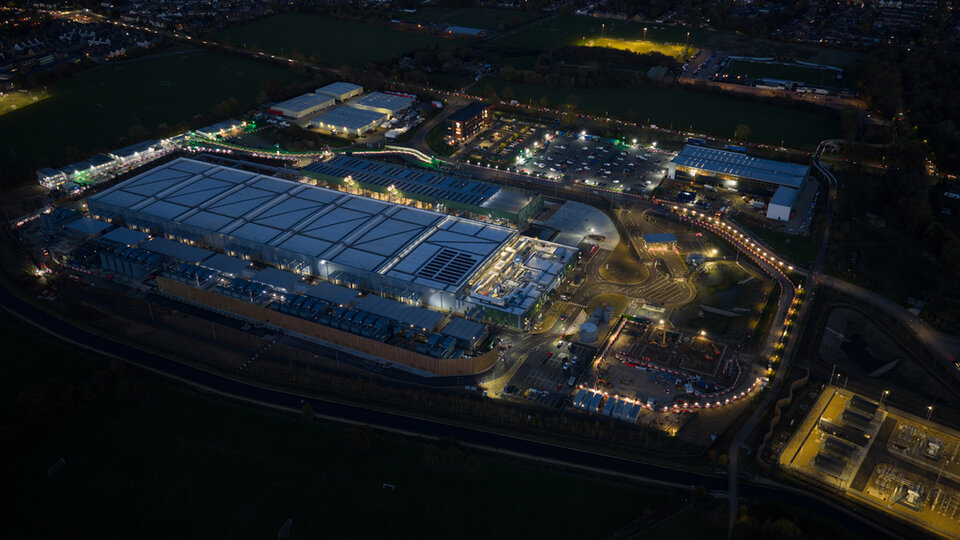
A data center under construction at Waltham Cross, England. Credit: Hugo Kirk/Getty Images
Some cities across the world have introduced moratoria on new data centre construction. Amsterdam has said it won’t allow new builds until at least 2030, due to extreme grid congestion and land scarcity. Three US cities – Denver, Tulsa and New Orleans – have voted for a temporary halt on new data centres, along with Edinburgh in the UK. Generally, these measures are seen as a short-term fix until sustainability standards can be defined. Dublin recently ended a three-year ban on new grid connections for data centres, replacing it with a tiered system based on energy demand.
“Frankfurt, London and Amsterdam collectively accounted for 33–42% of their local grid's entire electricity consumption by 2023, with Dublin approaching 80%,” says Franklin. “In Ireland alone, €5.8bn of data centre projects are stranded – these have planning permission and land; however, no grid connection.”
Grid limits reshape where data centres are built
In London, an outright ban seems unlikely. The majority of the UK’s build-out – planned
and existing – is clustered around the capital, with the nearby town of Slough thought to be the second-largest data hub in the world. That’s largely because of the prevalence of fibre networks in the area and the proximity of many data centre clients. However, City Hall has said a new data centre policy is coming, which will seek to balance the economic benefits with environmental concerns.
Over time, development may be pushed into secondary locations where infrastructure is more readily available. Wesley Daniel, technical director of power systems and infrastructure at Black & White Engineering, notes that securing grid capacity is getting harder in established markets. “This is changing how sites are brought forward,” he says. “Power availability is now a starting point rather than something resolved later. If a credible connection is not in place, the scheme is unlikely to proceed. In practice, that is creating a more distributed market, with new areas becoming viable as power, land and planning align.”
The QTS development is a good example. The site, which once hosted the coal-fired Blyth Power Station, will reportedly feature ten data halls totalling 720MW. It’s no accident, then, that this power-guzzling facility will be situated next to the North Sea Link: the world’s longest subsea interconnector, which links Norway to the UK and allows the two countries to share renewable energy. As Franklin puts it: “Private enterprise is now following the power.”
As well as taking a new approach to siting, data centre operators are also being forced to reconsider the design of the facilities themselves. “There is more focus on efficient cooling approaches, better use of available power and reducing reliance on water-intensive systems where possible. The challenge is increasing, but so is the level of engineering response to it,” says Daniel.
“Decisions on power capacity, cooling architecture and floor loading must be made now with confidence that they will support a future that is continually evolving.”
Mark Pestridge, executive VP and GM, Telehouse Europe
More attention is turning to on-site generation, which could reduce data centres’ reliance on the grid. For instance, real estate company Tritax Big Box is building a data centre near Heathrow Airport. As part of this plan, it has entered a joint venture arrangement with a renewable energy developer, which will provide it with accelerated access to power. Similarly, Pure DC is planning to deploy Europe’s first large-scale islanded microgrid on its Dublin campus. This 110MW on-site energy system provides scope for AI growth even when the public grid can’t keep pace.
“The operators and investors succeeding are those who treat energy as the primary strategic asset – securing, generating or rerouting power first, and building real estate around the supply,” says Franklin.
Developers must also respond to the distinct data usage patterns created by AI. Rather than designing for uniform density, they must accommodate uneven workloads, with high-density clusters sitting alongside traditional data centre racks. “Operators are moving towards modular infrastructure. Power, cooling and network capacity are designed in scalable blocks so facilities can expand as demand grows rather than overbuilding from day one,” says Keelan.
In other words, designing for flexibility and efficiency is essential. If the right decisions are made early on, the infrastructure will be in place to support future workloads without the need for major redesign.
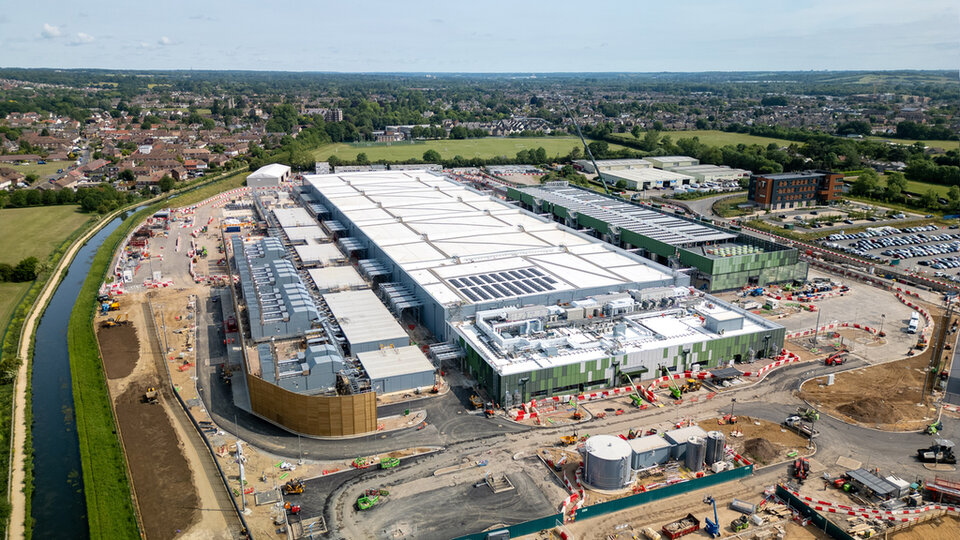
The Google Data Centre being built in Cheshunt, Hertfordshire, UK. Credit:Richard Newstead/Getty Images
A good example is Telehouse West Two, currently under construction at the Telehouse London Docklands data centre campus. This facility is set to open in 2028 – and according to Mark Pestridge, executive VP and general manager of Telehouse Europe, it must be able to tackle workloads we can’t envision today. “Decisions on power capacity, cooling architecture and floor loading must be made now with confidence that they will support a future that is continually evolving,” he says. “Underpinning everything is the need for sustainability to be embedded at the design stage, not retrospectively.”
Each floor of the building will deliver up to 4.4MW across a range of configurations, without forcing a single deployment model. It will integrate both air and liquid cooling techniques and has committed to 100% renewable energy. “These considerations all influence structural choices and plant space allocation from the outset,” says Pestridge. “AI-readiness is not a feature that can be simply retrofitted into a data centre – it stems from decisions made at the earliest design stages.”
Franklin contends that the window to get it right is “alarmingly narrow”. “The decisions made over the next three to five years – on where to site data centres, how to power them, how to plan infrastructure and how to govern their resource demands – will shape the energy system, the planning landscape and the communities hosting these facilities for decades,” he says.
If we get it wrong, the growth of data centres could prove to be an environmental and social catastrophe: consuming scarce resources to the detriment of everything else. However, the solutions are evidently there if we look for them. “The industry has the tools, the capital and increasingly the political support to do this well. What it needs now is the coordination to match its ambition,” says Franklin.

