Cover story
Retrofit vs rebuild
If stadiums and arenas offer high-profile examples of a broader question facing asset owners across the built environment – namely, when does it make more sense to refurbish rather than replace – what are the economic, environmental and operational factors ultimately influencing decision‑making? Martin Morris talks to industry experts to learn more.
Main video credit: vectorfusionart/Shutterstock.com
Powered by

Deciding whether to retrofit, by adding new systems or parts to an existing stadium structure, or to rebuild by tearing down the old structure and erecting a completely new one, economic and environmental factors will inevitably determine outcomes.
In the latter instance, stadium owners are increasingly looking to improve energy use by deploying measures such as solar panels or insulation, without compromising safety or changing the core framework. That is one of the reasons why retrofitting is in the ascendancy at present. Another, unsurprisingly, is that it is often cheaper than a rebuild from scratch, though costs vary by project and market, of course.
However, arriving at a decision, be it a retrofit or a rebuild, also means having to address issues such as long-term asset value and revenue generation.
As James Hamilton, director, global host cities and sports venues at Turner & Townsend, points out, “Long-term asset values are influenced by the design and operational life remaining of an existing venue, the volume of modifications or interventions required, compliance with regulations and surrounding asset growth potential.”
He adds, “Retrofitting will typically have value and revenue generation limitations due to flexibility requirements, including its existing structural capacity and adjacency to existing infrastructure. These factors cap the amount an asset can generate in monetary terms.”

James Hamilton, director, global host cities and sports venues at Turner & Townsend

David Hines, managing director of David Hines Sports Consulting

David Hirsch, associate director, architecture, Arup

Peter Broeder, AIA, design principal at HOK

Steve Fernandez, director and global building retrofit leader at Arup

What are the risks?
For Hamilton, retrofitting an older structure poses several risks that will need to be assessed before deciding whether to go down the refurbishment or demolition route. These risks can influence the business case, capex certainty and the overall development programme.
Risks span structural considerations including defects; loading capacity; existing foundations and columns to support a roof extension; concrete and steel degradation; and differential settlement. To mitigate these risks, solutions should include intrusive surveys and/or new structures to relieve existing capacity, according to Hamilton.
Alongside any structural concerns, operational risks during the retrofit include reduced capacity, a short to mid-term drop in revenue, temporary works costs, and health and safety factors, including fire and life safety systems, and the associated challenge of operating a live venue during the works.
Also needing to be factored into the equation are insurance premiums, licensing considerations, and potential spikes in building material prices.
Meanwhile, for David Hines, managing director of David Hines Sports Consulting, a new build will become more viable than a retrofit when the cost of keeping the existing venue operational, compliant, commercially competitive and attractive to fans exceeds the whole-life value of starting again.
As he puts it, “This is no longer just a construction-cost question; it is a question of asset age, maintenance liability, revenue limitation, compliance risk and future adaptability.” He adds, “The current trend is seeing stadia renovations and modernisation as a major growth opportunity.”
Expanding on his theme, Hines argues that long-term maintenance costs make a new build more viable when the existing stadium requires a sequence of major interventions rather than a single planned upgrade. If the venue needs structural strengthening, roof replacement, facade works, MEP replacement, fire and life-safety upgrades, accessibility improvements, seating bowl changes, new premium areas, improved concourses, digital infrastructure and sustainability upgrades, the project can quickly become a ‘retrofit in name only’.
At that point, the client may be spending near-new-build levels of capital while still retaining the limitations of the old asset, according to Hines.
The business case should therefore compare not just capital cost but also net present whole-life cost over 25–40 years. This should include planned maintenance, unplanned repairs, energy costs, replacement cycles, compliance risk, lost revenue during phased works, residual asset value and the opportunity cost of not being able to deliver modern commercial products, Hines adds.
Against this backdrop, a Deloitte Insights report (‘TMT Predictions 2025’) recently found the average age of US venues was around 27 years, placing many major venues near the point where substantial reinvestment is required. Given that the US sports stadium construction market was valued at an estimated $14.4bn/£11bn in 2025, with around 40% focused on upgrades and improvements rather than new builds, this offers significant scope for future business opportunities.
Whether one goes down the replacement or renovation route, David Hirsch, associate director, architecture, Arup, makes his own case for renovation, given that the foundations, primary structure and supporting infrastructure of a facility represent a substantial investment of materials and carbon that can often continue to perform for decades with the right interventions.

1.5
%
Global construction returns to growth in 2026, but only marginally, signalling recovery
without stability.
GlobalData
James Hamilton’s 5-step plan
1
Develop a long-term plan and vision for the stadium/venue
2
Consider lifespan, cost-in-use and development limitations/constraints of the existing stadium
3
Develop a robust business case for the new-build option and factor in year-round multi-use options
4
Develop realistic programmes for both options and assess how each will meet business objectives
5
Align the best option with a robust funding strategy that allows for all eventualities
Reducing carbon
These are important considerations, as retaining such elements can reduce embodied carbon, shorten construction programmes and preserve connections to the surrounding community. In some cases, older structures also possess architectural qualities that would be difficult or uneconomic to replicate today.
The issue of reducing carbon shouldn’t be underestimated, as Hirsch’s colleague, Steve Fernandez, director and global building retrofit leader at Arup, is quick to note. “A major structural retrofit will almost always deliver significantly lower embodied carbon than demolition and rebuild because it retains the primary structural elements where most carbon is already invested.”
Demolishing a facility not only releases emissions through demolition processes, waste handling, and material disposal, but also additionally creates demand for substantial new carbon-intensive materials, such as steel and concrete, to rebuild, according to Fernandez.
“By contrast, maximising structural retention through retrofit preserves this sunk carbon, often resulting in reductions of 50–75% in embodied carbon compared to an equivalent new build,” Fernandez adds, which is supported by a 2025 McKinsey & Company and World Economic Forum report, ‘Circularity in the built environment: Unlocking opportunities in retrofits’.
For Fernandez, though, the extent of the benefit depends on the condition of the existing asset and the scale of intervention required. That said, retaining and adapting viable structures is generally considered one of the most effective ways to reduce the whole-life carbon impact of a stadium redevelopment.
This principle is clear in transformation projects where the decision to use and upgrade existing stadia has been driven in part by the need to reduce construction-related emissions.
Another consideration in the retrofit vs rebuild debate is the existing stadium's footprint and whether it will limit options going forward.
Alexander Stadium case study
The UK’s Alexander Stadium in Birmingham is an international athletics venue.
Embedding sustainable planning into what amounted to a major £72m redevelopment, Arup added environmentally friendly features while increasing permanent capacity from 12,700 to 18,000 (approximately 42%). Meanwhile, reusing excavated materials lowered demand for raw materials and helped reduce construction traffic, showing how careful planning and materials management can reduce environmental impacts even on large, complex projects.
In short, it is often possible to deliver specific interventions that enhance capacity, accessibility, fan experience and operational functionality while avoiding some of the carbon and costs associated with wholesale replacement. Retrofit is typically an effective route to achieving both carbon and commercial outcomes, according to Arup.
Take advantage of public transport connections
Peter Broeder, AIA, design principal at HOK, argues, for example, that renovation allows teams to take advantage, where applicable, of existing public transit connections and tap into a public realm already associated with those facilities.
“HOK-designed renovations such as the Jacksonville Jaguars stadium and the Carolina Panthers Bank of America Stadium, for example, are both at venues located in the heart of the urban core,” says Broeder.
Transit planning is a key factor, according to Broeder, with adjacent development equally important – irrespective of whether the project is a new build or a renovation. “Increasingly, we’re seeing professional and collegiate sports organisations interested in developing surrounding properties and investing in nearby parcels that offer development rights,” Broeder adds.
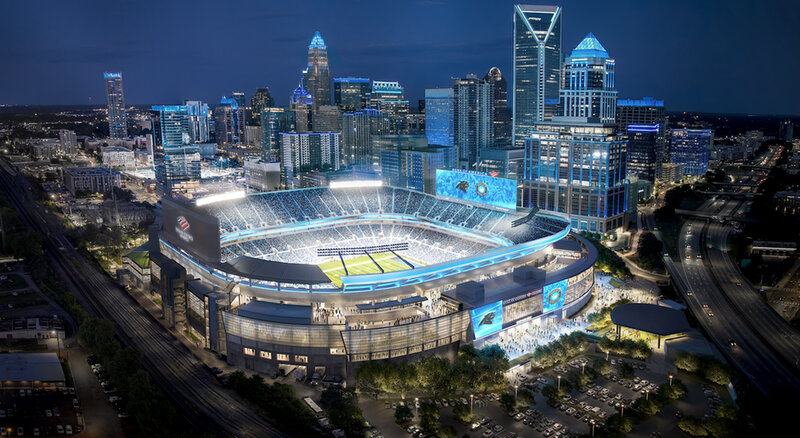
Carolina Panthers Bank of America Stadium. Credit: HOK
The opportunity to integrate adjacent development can be a major advantage for a franchise, as it allows the venue to serve as a catalyst for vibrant neighbourhoods and an active urban environment. Ultimately, the goal is to create destinations that are active year-round by expanding the venue’s event offerings.
Many in the industry will argue that there are structural advantages to keeping the old skeleton of an arena rather than tearing everything down and starting from scratch.
Broeder certainly thinks so, saying there are both economic and sustainability advantages in doing it. “If a building has good bones and can be successfully renovated, owners don’t need to make the same capital investment required to completely rebuild the structure.”
From a sustainability perspective, you’re also able to work with existing materials and resources rather than replacing them.
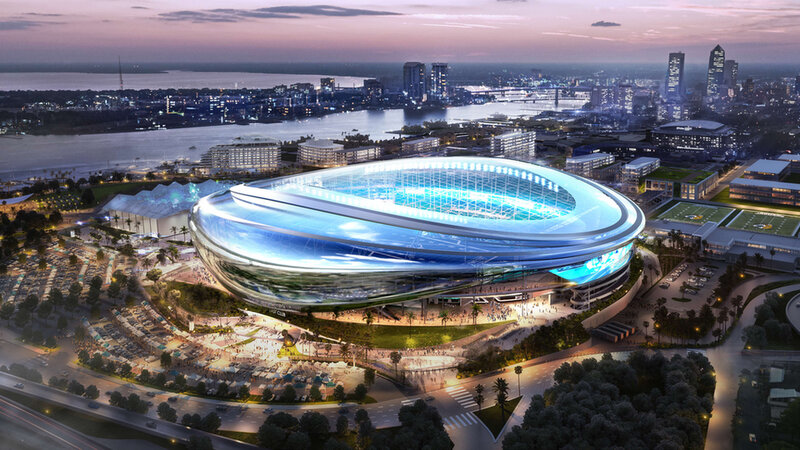
Jacksonville Jaguars stadium. Credit: HOK
But as Broeder notes: “That said, I wouldn’t necessarily say renovation is easier. Working with an existing structure creates its own logistical and technical challenges. If you can successfully work with the existing structure, the cost and sustainability benefits can be enormous, but it requires extremely careful planning from both the design team and the construction team.”
The retrofit vs rebuild debate is a complicated one, defined by the many financial and sustainability factors that need to be considered at the outset – not least those that could lead to cost overruns later. In other words, where a retrofit is being considered, ensure costs are realistically kept under control at the outset to prevent the project from turning into ‘a retrofit in name only’.

