Feature
The power problem
The energy transition is creating huge demand for data centres, battery plants, EV factories, transmission networks, renewable energy projects and other major infrastructure. Abi Millar asks if the construction industry has what it takes to build this infrastructure at the required pace. And what will the consequences be if it cannot?
Main video credit: BlackBoxGuild/Shutterstock.com
Powered by

The energy transition is happening – and it’s happening fast. As countries race to meet their ambitious net-zero goals, they are trying to build the required infrastructure at unprecedented speed. That means everything from underground substations to EV battery gigafactories. Projects of this nature are being approved and funded despite the many roadblocks they have faced in the past.
In the UK, there are around £455bn worth of net-zero energy infrastructure projects in development, according to a report by CBI Economics. This includes offshore wind, solar, hydrogen and energy storage, totalling around 262GW of capacity. National Grid Electricity Transmission has published a business plan proposing up to £35bn in investment in England and Wales over the five years to March 2031, while, according to the Faraday Institution, the UK requires the equivalent of ten gigafactories by 2040 to meet electric-vehicle and broader battery demand.
It’s a similar story elsewhere. Several European countries and the EU are placing increasing focus on carbon capture and storage technologies, along with cross-border networks for CO2 transport. The idea is to capture CO2 emissions at their source, before moving them to locations suitable for permanent storage. By 2050, the EU could be capturing around 250 million tonnes of CO2 every year, while the CO2 transport network could stretch to up to 19,000km.
The scale of the planned buildout is encouraging. It suggests that many countries are serious about the energy transition and are preparing to invest heavily to advance their net-zero commitments. On the other hand, promising a certain amount of infrastructure is not the same as delivering it. Behind the scenes, some project developers are concerned they have taken on more than they can deliver.
As Neeral Shah, CEO and founder of YardLink, puts it: “The buildout is hitting a construction industry that is already stretched, with a deepening skills shortage, and supply chain processes that were never built to handle this kind of volume or complexity.”
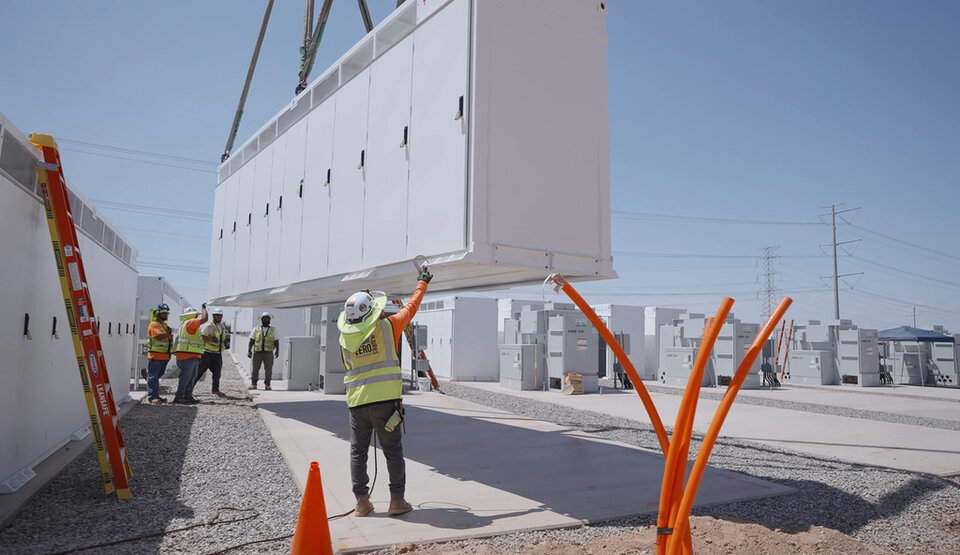
The installation of a Battery Energy Storage System (BESS) container unit at an energy facility in Phoenix, Arizona. Credit: harhar38/Shutterstock.com
Robert Hedges, associate sustainability engineer at Service Design Associates, agrees. He points out that even tackling one small facet of the energy transition – say, electrifying domestic heating – requires a major infrastructure upgrade.
“Replacing around 300TWh of annual heat demand with heat pumps would require roughly 85–90TWh of additional electricity, assuming typical seasonal efficiencies,” he says. “That is equivalent to around one-third of current UK electricity consumption by end users. And it’s before accounting for growing demand from electric vehicles, industry, commercial buildings, data centres and wider economic growth.”
In his view, the energy transition requires far more than replacing fossil fuels with low-carbon technologies – not that this is an easy task in itself. Rather, it requires an expansion of generation capacity, transmission and distribution networks. It also requires a scale-up of energy storage technologies and a step-change in system flexibility.
“The investment required over the coming decades is measured not in incremental upgrades, but in a transformation of the UK’s entire energy system,” he says.
The green skills gap
One of the most pressing problems for the industry is the growing green skills gap. To use the UK as an example, official analyses indicate that meeting decarbonisation targets for buildings will require significant workforce intervention. This could mean training or reskilling hundreds of thousands of workers and may also require bringing in talent from overseas.
According to early insights from the forthcoming Turner & Townsend 2026 Global Construction Market Intelligence report, labour shortages – particularly green-collar labour – are among the biggest constraints to delivering projects in the UK. Government strategies aim to support up to 440,000 jobs in net-zero industries by 2030, contributing to a wider goal of up to two million green jobs by 2030; many of these roles are expected to be in construction and related trades.

£455
bn
Value of the net-zero energy infrastructure projects in development in the UK.
CBI Economics
In the meantime, there is a mismatch between the existing workforce (who may have been trained under quite different circumstances) and the skill set that will be required. According to Greg Pitt, vice-president of battery materials at Worley, many project teams are trying to commercialise new technologies while designing and constructing large industrial facilities.
“That introduces a level of technical and execution risk that is very different from traditional infrastructure programmes,” he says. “There is a major constraint due to the lack of experienced project delivery capability. Across many markets, there are simply not enough people with experience delivering complex industrial projects at the pace required.”
Hedges notes that, as the industry electrifies, a wide range of projects are likely to compete for the same limited pool of engineers and installers. (Think building services, power networks, renewables, battery storage, EV infrastructure and more.) “The industry is also adapting to a fundamental shift from gas-fired to all-electric buildings, requiring new skills in load management, energy storage and smart controls,” he says.
Other roadblocks ahead
Another sticking point is the supply chain. As Shah explains, the construction supply chain is still largely relationship-based and analogue. Many companies still rely on traditional methods of managing suppliers, such as spreadsheets, email chains and phone calls.
“This just about works when project volumes are manageable and the supplier base is familiar,” he says. “But it breaks down completely when you need to rapidly scale to meet the demands of multiple gigafactory builds and renewable energy projects happening simultaneously.”
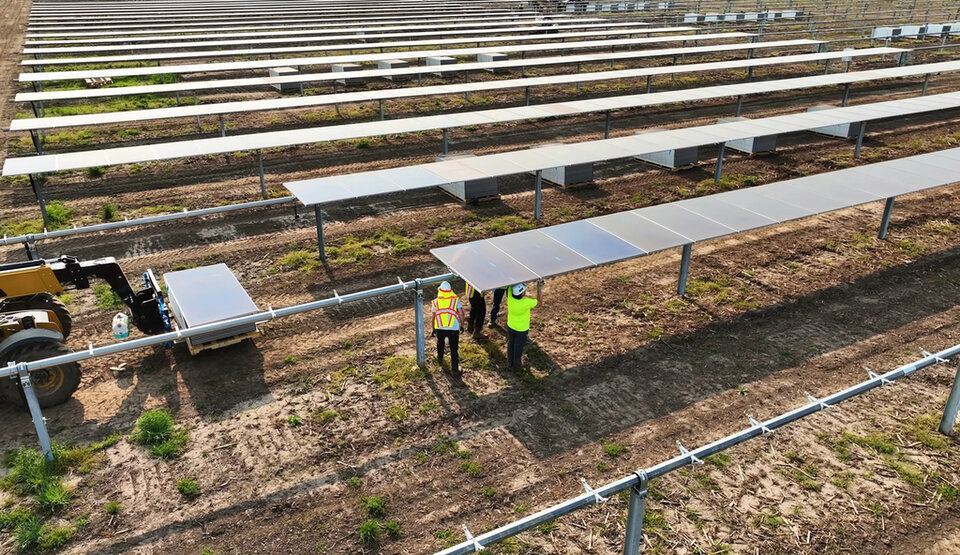
Solar technicians working at a ground-mounted photovoltaic (PV) solar farm. Credit: harhar38/Shutterstock.com
For instance, companies may find themselves unable to obtain the equipment they require. Large-scale infrastructure builds require significant specialist equipment, and if multiple projects compete for the same kit, costs can spike and lead times can extend. Similarly, any changes in materials prices can have a major impact. “We’ve already seen what steel tariff disruption does to supply chain confidence,” notes Shah.
Yet another bottleneck is grid capacity. Hedges remarks that he has seen several projects delayed because local networks could not accommodate additional demand or generation. “Grid connection is increasingly becoming the critical path for delivery [in many areas],” he says.
Shah warns that, if the industry doesn’t get these issues under control, there could be delays and cost overruns on a scale not previously seen. That has sobering implications for the energy transition, since net-zero targets depend on this infrastructure being built on time.
“If construction can’t keep pace with the demand for battery plants, transmission networks and renewable energy projects, the energy transition itself slows down,” he says.
It could also weaken national energy security and leave consumers more exposed to volatile energy prices. “Delays caused by skills shortages, grid constraints or inefficient delivery could also discourage investment and reduce the UK’s competitiveness,” says Hedges.
What can the industry do?
So given the herculean task ahead – and the formidably high stakes – what can the industry do to maximise its chances of success? Pitt calls for more rigorous front-end planning and earlier collaboration among project participants. That means clients, designers, contractors and operators should work together from day one.
“In the race to hit deadlines, projects can sometimes move into execution before sufficient planning has been completed,” he says.
Digital tools can be very helpful in this quest. Craig Wheatley at climate tech firm IES suggests implementing predictive modelling early in the design process – in other words, testing different scenarios long before construction gets under way. This helps project teams make evidence-based decisions and reduces the risk of problems emerging further down the line.
“Physics-based building performance modelling creates a virtual representation of an asset, allowing teams to test how it will perform before construction starts,” he says. “Without this modelling, projects risk delivering buildings and infrastructure that aren’t resilient or suited to future climate conditions, potentially affecting long-term performance and adaptability.”

£35
bn
Proposed investment in England and Wales over the five years to March 2031
National Grid Electricity Transmission
On the supply chain front, Shah believes that three things need to change. First, procurement needs to become more transparent, moving away from a relationship-based model and towards pre-vetted supplier networks. “This means more choice without more risk,” he says.
Second, procurement needs real-time visibility; for instance, by using live spend tracking and project-level budget control. Finally, teams need to move towards automated solutions that can save time and lighten their administrative load. “Overall, the supply chain needs to scale in capacity and intelligence,” says Shah.
There’s a lot to consider, but despite the scale of the challenge, Hedges remains largely optimistic. “I believe the industry has the engineering capability and innovation needed to deliver the energy transition,” he says. “From my experience, the industry is not short of innovative solutions and [is] reinventing old ones to meet modern problems. The challenge is giving organisations the confidence and certainty to invest in delivering them at scale.”
A business-as-usual approach will not suffice. There is simply too much to accomplish. All this said, the construction industry has a long history of taking on major challenges. Arguably, with many core technologies already available and political momentum building, success now hinges on implementing the right delivery processes.
“The real challenge is integrating infrastructure, engineering, digital technology and skilled people effectively enough to deliver the transition at the scale and pace required,” says Hedges.

