
Megaproject update
Neom: When the vision meets the bill
Location: Saudi Arabia
Type: Mixed use
Estimated cost: $500bn–$8.8tn
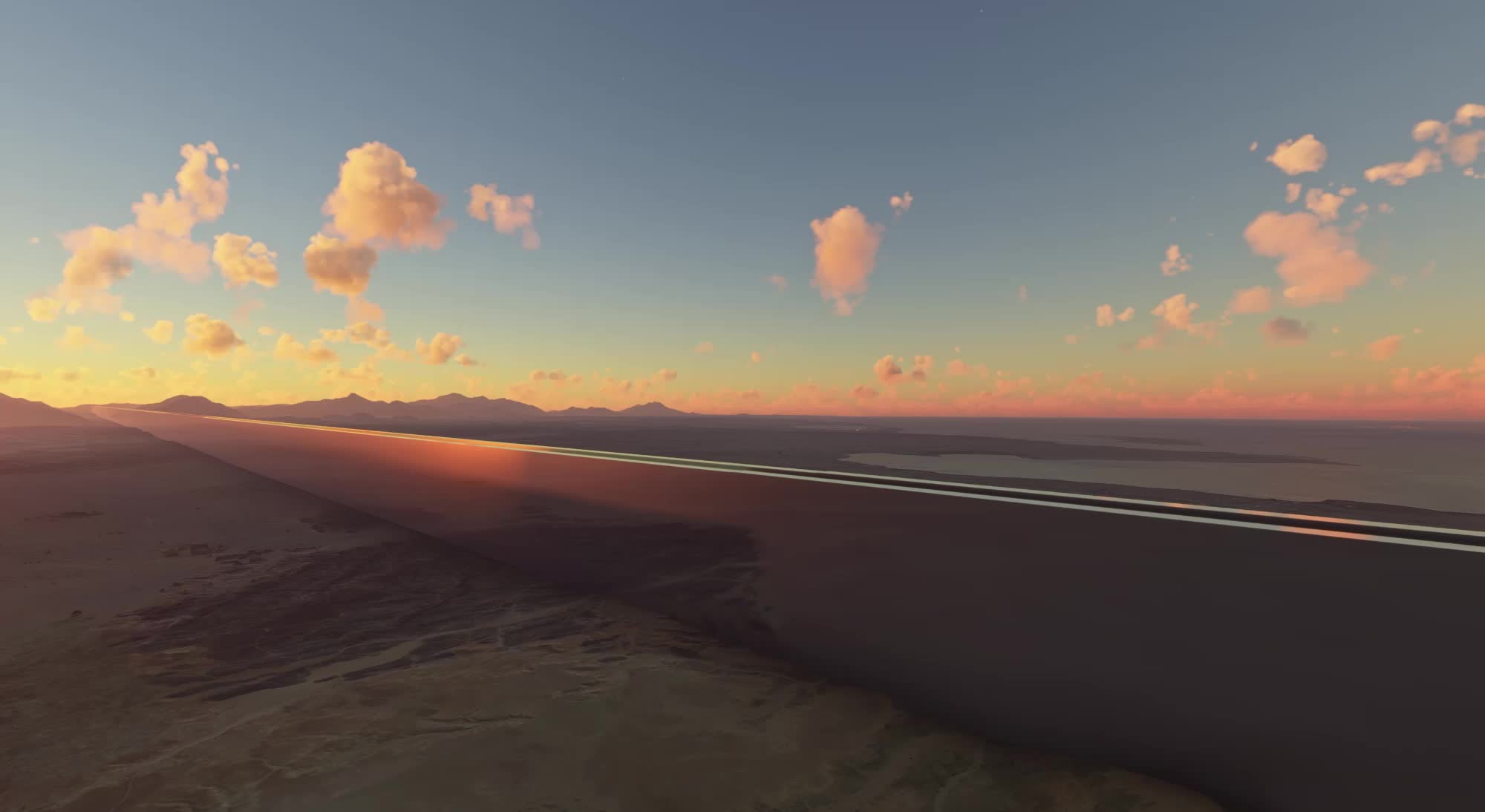
Main video: The Line in Neom. Sunset aerial view of Sharmah. Credit: Soonios Pro/Shutterstock.com
Powered by

The global construction outlook is edging back into positive territory. On paper, that looks like a recovery. In practice, it is something more awkward: a return to growth in an industry that has lost the comfort of stable assumptions.
Worldwide construction output is forecast to grow by 1.5% in 2026 after a 0.2% decline in 2025, according to GlobalData’s Global Construction Outlook: Key Trends and Opportunities to 2030 (Q1 2026). Those figures matter, but they are not the whole story. The more useful signal is what sits beneath them: geopolitical disruption, elevated input costs, strained labour markets, tighter finance and a growing question over which projects can be delivered profitably.
Demand has not disappeared. Governments still need transport networks, grids and utilities. Corporates still want logistics capacity, semiconductor plants and data centres. What has changed is the threshold for turning that demand into viable work. The industry is now deliverability constrained.
That is why the global construction disruption outlook is a test of commercial discipline.
When the vision meets the bill
There are megaprojects, and then there is NEOM, or was NEOM.
Announced in October 2017, the development was conceived as a cornerstone of Saudi Arabia’s economic transformation. The original announcement said NEOM would be backed by more than $500bn from the Kingdom, its Public Investment Fund and private investors, with a vast new region in the north-west intended to create industries, jobs and economic activity beyond oil.
Then came The Line.
First announced in January 2021, its vision was presented as a 170km-long city contained within two parallel structures 200m wide and rising 500m high. The full build-out population target was nine million residents.
Much has since been written about whether The Line could ever be delivered as originally conceived. Polemic investigations by publications including the Financial Times and Wall Street Journal have examined its escalating costs, engineering challenges, changing scope and internal decision-making.
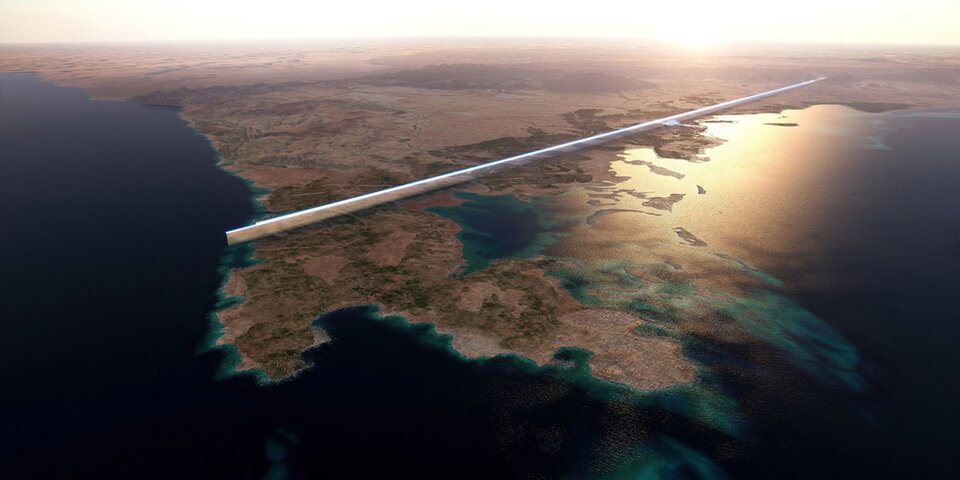
A renderings of the mirrored linear structure stretching across the desert, built at a scale rarely contemplated before. Credit: PRNewswire
But The Line also presents a broader question for construction: what happens when the scale and assumptions underpinning a programme change after the machinery of delivery has already started moving?
Nine years after NEOM was launched, the programme looks very different.
Executives stated that more than $50bn had already been spent on NEOM. An internal audit reviewed by the WSJ estimated that delivering The Line to its original specification by 2080 could require around $8.8tn in capital expenditure.
The two figures are not directly comparable, of course. NEOM’s original $500bn was described as backing for the wider NEOM region rather than a fixed construction budget for The Line. At the same time, the $8.8tn figure was an internal projection for delivering The Line to its original specification over several decades.
But the distance between them gives some sense of what happened as an extraordinary concept was worked through as a deliverable project.

2017
NEOM announced under Vision 2030 with a $500bn+ investment framing.

2020
Green hydrogen/ammonia project announced (July).

2022
Trojena announced (March); Sindalah announced (Dec); Duba Port management transferred to NEOM.

2024
The Line’s 2030 scope is cut to ~2.4 km; reported cost estimates for the wider vision rise sharply.
2026
Further work on The Line is deferred until after 2030; Trojena dam/lake contracts are terminated; the green hydrogen project advances towards commissioning and first ammonia production in 2027.

2019
NEOM Company incorporated (Jan); NEOM Bay Airport receives its first commercial flight (June).

2021
The Line announced (Jan); early construction and site works begin.

2023
NEOM Green Hydrogen Company reaches financial close at $8.4bn (May).

2025
Aiman Al-Mudaifer formally appointed CEO (May); internal cost concerns and project reviews become public.
A development such as The Line requires structures, transport, utilities, power, water, logistics and digital infrastructure to function as an integrated system. Each carries its own programme, interfaces and dependencies. Alter the scale or sequence of the overall scheme and those assumptions move with it.
The consequences of that sequencing were already becoming visible on site. The FT reported that piling began in 2022 before detailed design of the building had been completed. Around 6,000 piles were installed across roughly 2km of desert before the planned first phase was progressively reduced from 20 modules to three.
In May, Semafor reported that further work on The Line had been delayed until after 2030 following a strategic review, while investment was being redirected towards areas including ports, utilities and data centres. NEOM has not publicly abandoned The Line and describes it as a long-term development being advanced through a phased, demand-led approach.
Changing course at this scale has consequences far beyond the construction that no longer goes ahead.
Semafor also reported that NEOM’s 2026–30 budget included around 60bn Saudi riyals – approximately $16bn – in anticipated payments to terminate long-term contractor agreements.
As a programme moves from design into procurement and construction, commitments begin to accumulate. Contractors mobilise, designers expand teams, equipment is ordered and supply chains invest in capacity. Commercial arrangements are built around assumptions about what will happen next.
If those assumptions change, the costs do not disappear.
The experience also raises questions about governance.
Reporting on the project has questioned whether NEOM’s governance and internal controls kept pace with the scale and speed of its ambitions. The FT reported that an internal audit launched in 2023 examined escalating costs and schedule extensions, while former employees described difficulties in challenging assumptions and escalating concerns through the organisation.
An internal audit reviewed separately by the WSJ also raised questions about expense estimates for The Line and how escalating costs were handled in project planning.
Major programmes rely on uncomfortable information travelling upwards.
Cost forecasts have to withstand challenge, programme assumptions have to be tested against what the supply chain can actually deliver, and design decisions have to be considered alongside their commercial and construction consequences.
That becomes much harder once optimism is embedded in the baseline. By the time assumptions are revisited, procurement may be under way, contractors mobilised and capital committed.
NEOM itself is still moving, however. The Port of NEOM is handling limited cargo, with its new container terminal expected to begin operations in 2026 and ramp up from 2027.
It is a long way from the imagery that first brought NEOM global attention.
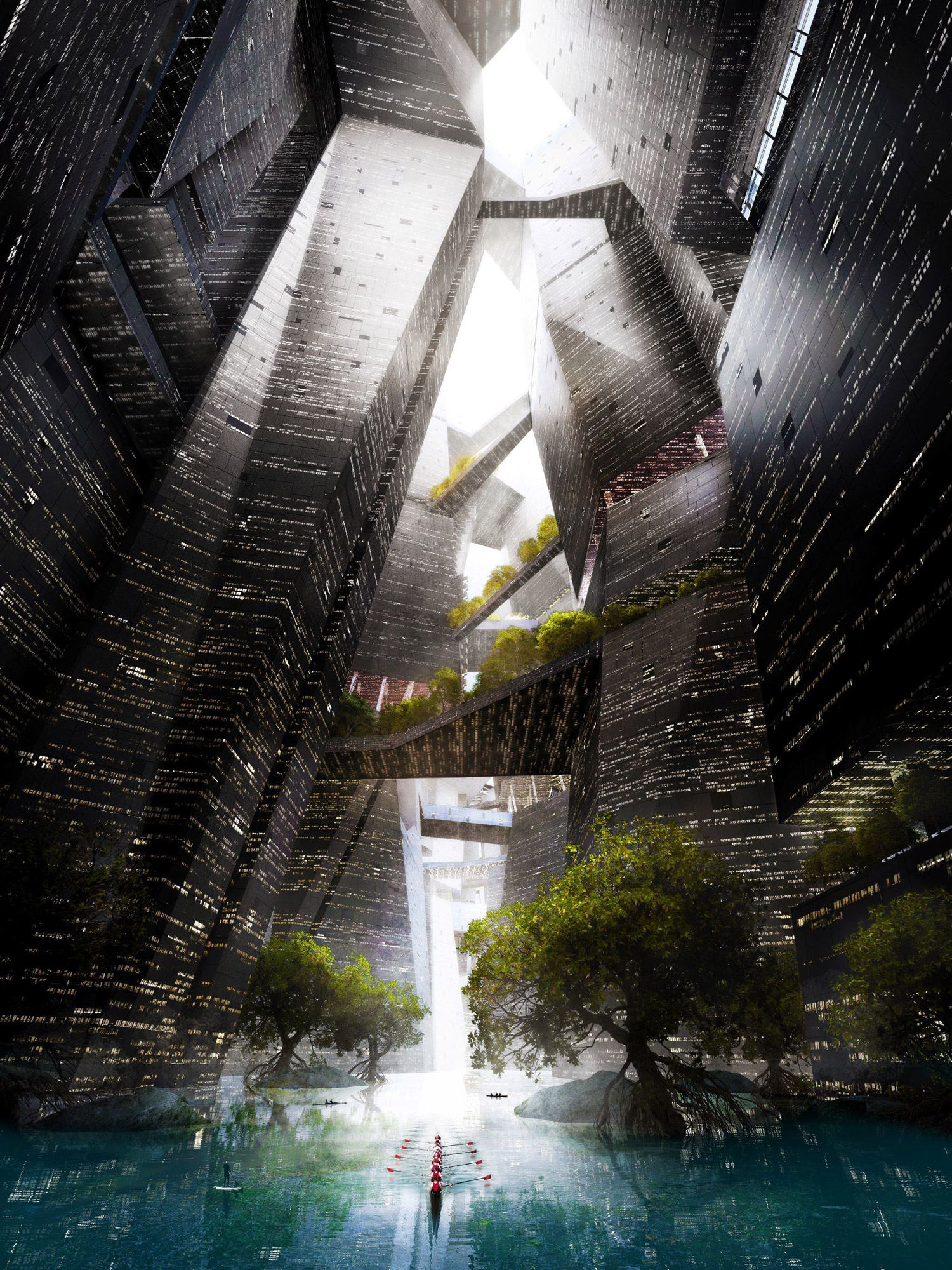
Early concept images for The Line. Credit: PRNewswire
The programme being described today is increasingly shaped by phasing, infrastructure, industrial capacity and demand.
None of those things makes for a particularly spectacular rendering. They are, however, the things construction programmes eventually have to confront.
NEOM began with a vision of what could be built. Nine years on, its development is being shaped by the more familiar constraints of what can be financed, sequenced, contracted and delivered.
And once billions have been committed and a global supply chain has mobilised, changing the vision carries its own cost.
We investigate the Middle East's construction sector in more detail in this issue's Regional focus

The Line's city of the future remains unrealised. Credit: PIF

